The European Accessibility Act for websites and online stores
Since 28 June 2025, businesses that sell covered products or services to consumers in the EU must make them accessible, including their websites, apps and online shops.
At a glance
Checked against the official sources on 13 September 2026. General information, not legal advice.
- Applies since
- 28 June 2025.
- Who it covers
- Products sold in the EU and services provided to EU consumers, wherever the business is based.
- Services in scope
- E-commerce, consumer banking, e-books, electronic communications, access to audiovisual media, and air, bus, rail and waterborne passenger transport, including their websites, apps and e-tickets.
- Exemption
- Microenterprises providing services, meaning fewer than 10 people and annual turnover or balance sheet of no more than EUR 2 million.
- Standard
- EN 301 549. The version currently cited, v3.2.1, is based on WCAG 2.1 AA. Version 4.1.1, published in September 2026, moves to WCAG 2.2 AA and is waiting to be cited in the Official Journal.
- Penalties
- Set by each member state. Germany allows fines of up to EUR 100,000. In Ireland, a conviction on indictment can bring a fine of up to EUR 60,000.
Key dates
| Date | What happens |
|---|---|
| 28 June 2025 | Accessibility requirements apply to covered products and services. |
| 28 June 2030 | End of the transition for services that keep using products they already used before 28 June 2025. |
| Up to 20 years in use | Self-service terminals already in use may stay until the end of their useful life, for no more than 20 years, where the member state allows it. |
What it means for a website
For an online store or a service's website, the practical target is the web section of EN 301 549, which follows WCAG Level AA.
An audit against WCAG 2.2 AA covers the WCAG 2.1 AA criteria in the current standard, apart from 4.1.1 Parsing, which WCAG 2.2 removed, plus the newer criteria the updated standard adds.
For agencies with EU clients
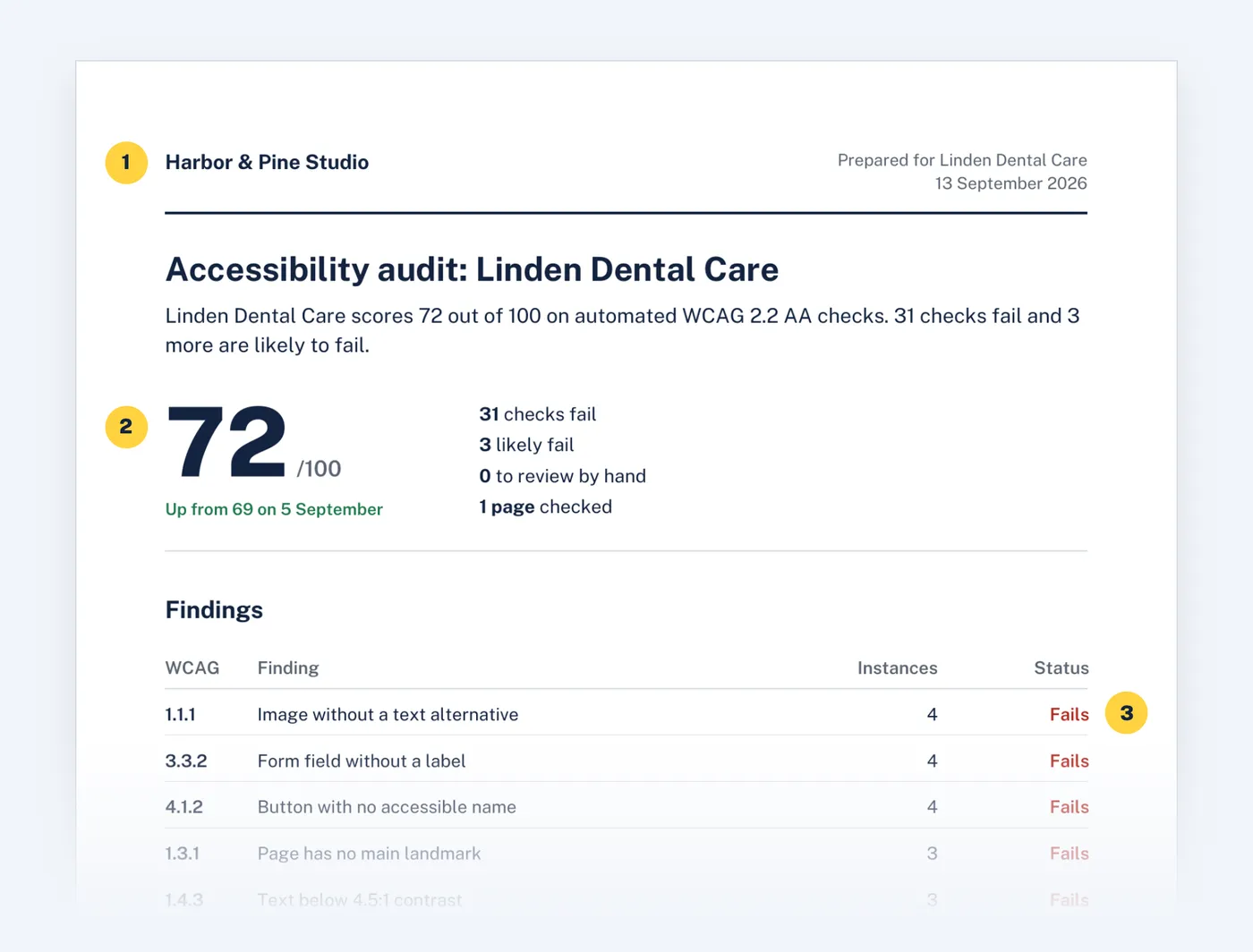
Clients who sell to EU consumers will ask whether their site meets the Act. A dated audit shows where each site stands, what was fixed and what still needs a person to review, without claiming more than automated checks can show.
Where AccessGuard helps
An audit shows what fails today and keeps a dated history as fixes land.
- WCAG 2.2 AA audit
- Automated checks on each page as the browser renders it, with every finding mapped to a criterion.
- Reports for the client
- A PDF under your agency's name that explains each failure in plain words.
- A record of progress
- Scan history shows what failed, when it was fixed and what's new since the last audit.
What an audit can't do
- It can't confirm that a site conforms to the Act. Only part of WCAG can be checked automatically.
- It checks web pages, not mobile apps, PDFs or self-service terminals.
- This page is general information, not legal advice. Ask a lawyer about a specific business.
Questions
Does the European Accessibility Act apply to businesses outside the EU?
It applies to products sold in the EU and services provided to EU consumers, wherever the business is based.
Are small businesses exempt?
Microenterprises that provide services are exempt from the service requirements. That means fewer than 10 people and annual turnover or balance sheet of no more than EUR 2 million.
Which version of WCAG does the Act use?
The Act points to the harmonised standard EN 301 549. The version currently cited is based on WCAG 2.1 AA. The new version published in September 2026 moves to WCAG 2.2 AA.
Can an automated audit show a site meets the Act?
No. Automated checks find many common failures, but criteria such as meaningful alt text or a logical focus order need a person to review.
Related
- ADA and business websites
US businesses open to the public. There is no federal web standard under Title III, and WCAG is the usual benchmark.
- ADA Title II web rule
State and local governments and public colleges must meet WCAG 2.1 AA by April 26, 2027 or April 26, 2028, depending on size.
- Section 504 web rule
Recipients of HHS funding, including many healthcare providers, must meet WCAG 2.1 AA by May 11, 2027 or May 10, 2028.
- Color contrast checker
Measures text and control colors on the rendered page against the WCAG 2.2 AA ratios, and flags links that differ from text by color alone.
- Form labels checker
Finds inputs without labels, placeholders used as the only label, and fields that don't say what they collect.
- Keyboard and focus checker
Finds controls people can't reach by keyboard, focus styles that were removed, and focused elements hidden behind sticky headers.
- WCAG 2.2 checklist
Every A and AA criterion, and how much of each an automated audit can check.
See where a client site stands today
Run a free WCAG 2.2 AA audit of any page. Results in about a minute.